Try our newest merchandise


Based by Georges Eberhard in 1887 in La Chaux-de-Fonds, Eberhard & Co. had established itself as a purveyor of progressive, technically superior chronographs by 1919. Though the unbiased model is well-known amongst Italian collectors, and its Chrono 4 mannequin, with 4 separate counters impressed by the dashboard of race automobiles, may resonate with some readers, its wealthy chronograph historical past stays largely undiscovered by a wider viewers. To handle this hole, Eberhard created the 1887 assortment impressed by historic chronographs on show within the model’s museum. Some of the enticing retro-inspired fashions within the assortment is the Chronograph 1887 Restricted Version. This subtle flyback chronograph, impressed by the model’s chronographs of the Nineteen Thirties, is available in a up to date case dimension, is powered by a up to date manual-winding motion and manages to chop a dashing retro-chic determine.

Eberhard’s mastery of wristwatch chronographs on the flip of the 20th century is up there with a few of the better-known names resembling Longines, Common Genève, Lemania and Landeron. In 1919, Eberhard produced its first chronograph wristwatch, thought-about essentially the most superior single-pusher chronograph of its day. In 1935, the model launched an progressive double-pusher chronograph, providing cease and begin capabilities with out requiring a reset to zero. Three years later, Eberhard produced the primary chronograph with an hour counter, adopted in 1939 by its first split-seconds chronograph.

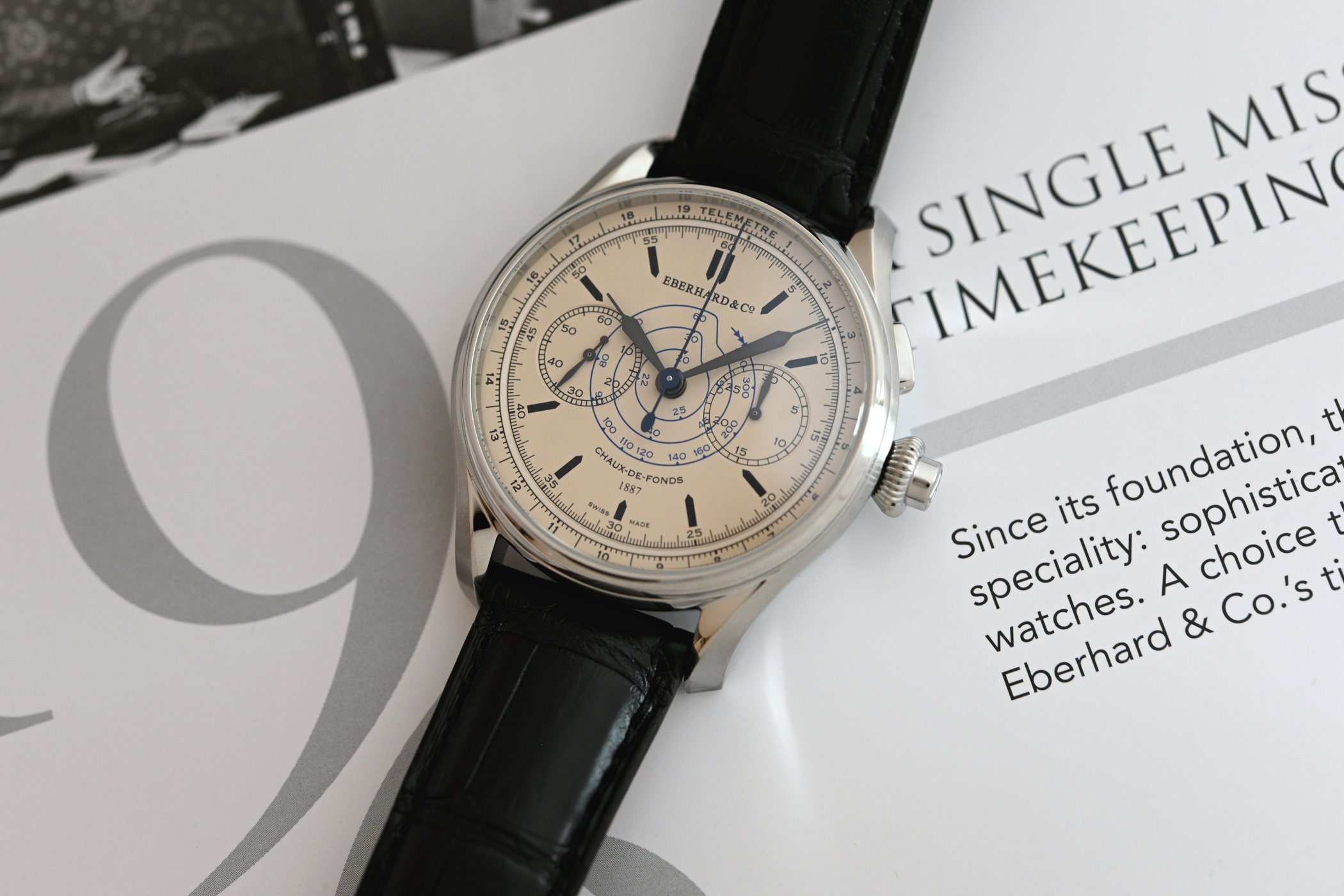
The muses behind the Chronograph 1887 Restricted Version fashions are Eberhard’s historic chronographs. Whereas the dial replicates the format, telemeter scale and central spiral of the 1935 chronograph, it’s a synthesis, in a up to date key, of the model’s Nineteen Thirties chronographs. The stainless-steel case, for instance, is a profitable mix of previous and new. The 41.5mm case dimension is distinctly modern, with a strong top of 13.9mm, sapphire crystals on each the back and front, and a depth ranking of fifty metres. In distinction, the outsized crown has a classic pilot’s watch vibe, and the lyre lugs a Fifties aptitude.
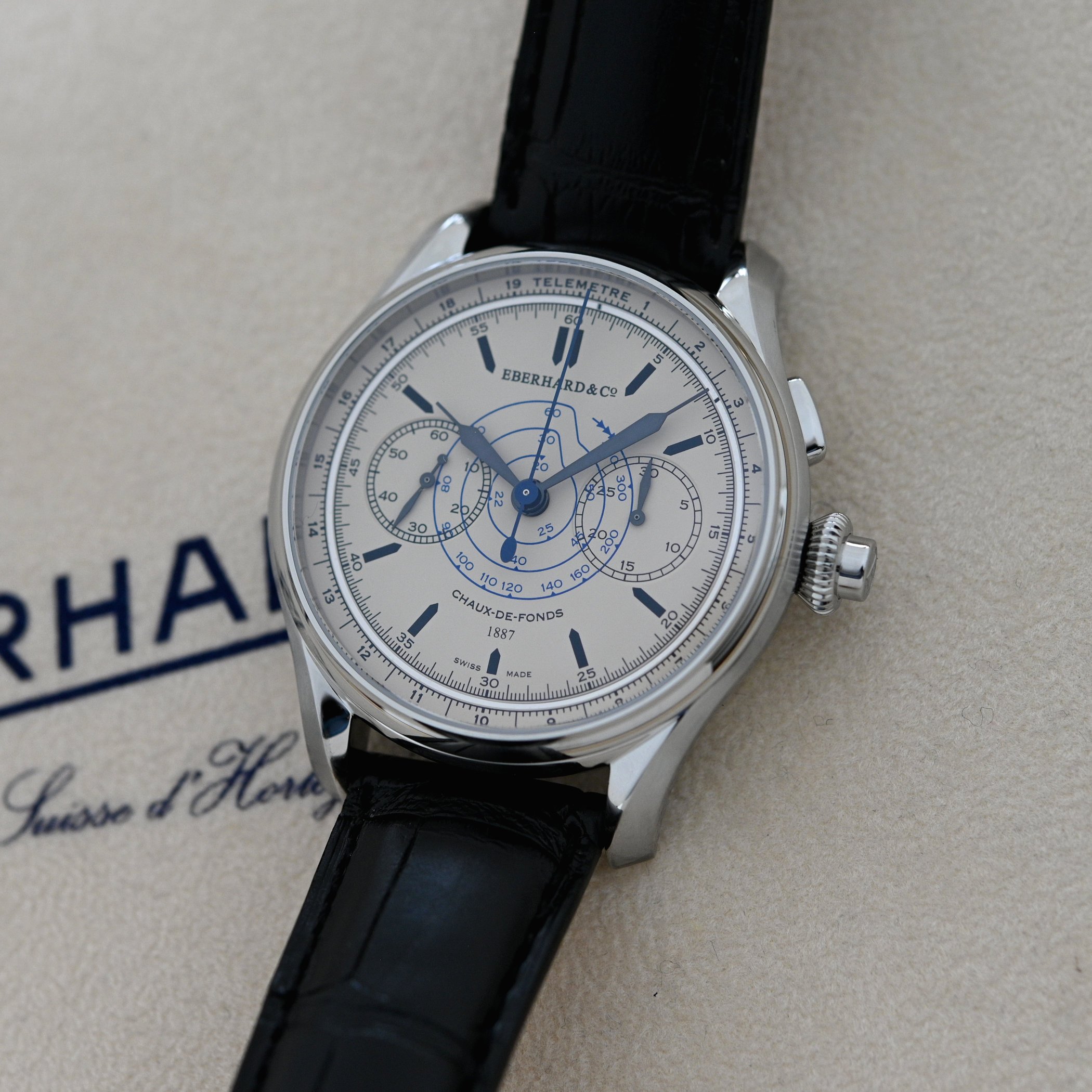
Flyback problems originated within the Nineteen Thirties and have been utilized by pilots to make fast, successive time measurements throughout missions. The oblong pusher above the crown is used to begin and cease the chronograph. If the chronograph is stopped, the coaxial pusher contained in the crown is used to reset it. Nevertheless, if the chronograph is working, the pusher contained in the crown prompts the flyback operate, and the central chronograph hand flies again to zero to begin a brand new run of measurements.

Obtainable in three dial colors, together with salmon and black, we photographed the eggshell or off-white version. All three dials undertake design options of the 1935 chronograph, with a peripheral telemeter scale and a curious blue spiral within the centre of the dial with chevrons on its tail, intersecting each counters. Greater than a lovely design function, the numerals on the spiral (working from 20 to 400 km/h) correspond to the tachymeter scale.

One benefit of getting a big case dimension is that there’s ample room for the dial to showcase its charming retro character. Though not a extremely demanded operate on a chronograph at this time, the telemeter scale was as soon as a significant ally in wartime theatres to calculate fireplace vary in battle. Right here, the telemeter/minutes scale is expressed in 1/5th-of-a-second readings. Separated by a metal ring, the central space of the dial has a traditional bicompax format with 30-minute elapsed instances at 3 o’clock and working seconds at 9 o’clock. Aligned horizontally and intersected by the model’s blue spiral, the sub-dials function conventional black railroad tracks. The eggshell and semi-matte black dials use hour indices, whereas the salmon/bronze dial options Arabic numerals at 12 and 6 o’clock. Usually used on classic pilot watches, the syringe-style hour and minute arms have pointed suggestions for precision readings.

The manual-winding motion was developed in collaboration with Manufacture AMT, the high-end division of Sellita. Utilizing a Sellita AMT5100 base, the manual-winding EB 280 calibre controls the flyback chronograph with a column wheel. Extensively modified, the motion encompasses a particular lever that permits the chronograph reset pusher to be displaced coaxially with the crown. One other bespoke contact is the shield-shaped bridge embellished with Côtes de Genève. Referred to as a poinçon de maître, or a maker’s mark, Eberhard registered its defend in 1892. With a frequency of 28,800vph, a strong 62-hour energy reserve, the motion is additional protected by an Incabloc anti-shock machine, an anti-magnetic Nivaflex mainspring and options hacking seconds.
The three Chronographe 1887 references are paired with alligator leather-based straps and metal pin buckles. They’re restricted editions of 250 items per color and retail for EUR 6,960.
For extra info, please go to Eberhard-co-watches.ch.
https://monochrome-watches.com/first-look-review-eberhard-and-co-chronographe-1887-edition-limitee-eb-280-flyback-chronograph-sellita-amt-5100-specs-price-live-pics/